All published articles of this journal are available on ScienceDirect.

Preoperative Albumin-to-Fibrinogen Ratio as a Prognostic Biomarker in Bladder Cancer: A Systematic Review and Meta-Analysis

Abstract
Introduction
The Albumin-To-Fibrinogen Ratio (AFR) reflects both nutritional status and systemic inflammation, which are critical determinants of cancer prognosis. This systematic review aimed to evaluate the prognostic value of preoperative AFR in patients with bladder cancer.
Methods
This review was registered in PROSPERO (CRD420251110236). PubMed, the Cochrane Library, and EBSCOhost were searched up to July 2025 for studies reporting preoperative AFR (or its reciprocal, FAR) and survival outcomes in patients with histologically confirmed bladder cancer. Hazard Ratios (HRs) for Overall Survival (OS) were pooled using Review Manager and STATA, while progression- and recurrence-related outcomes were synthesized narratively because of differences in endpoint definitions.
Results
Four studies involving 1,381 patients were included. Preoperative AFR was not significantly associated with OS (HR 1.41, 95% CI: 0.51–3.94, p = 0.51). Individual studies generally suggested an association between lower AFR and unfavorable recurrence or progression outcomes.
Discussion
AFR may reflect the combined effects of systemic inflammation and nutritional status; however, differences in disease stage, treatment modality, and cut-off values limit interpretation of the pooled results.
Conclusion
Lower preoperative AFR was associated with unfavorable oncological outcomes in individual studies; however, the pooled analysis showed no significant association with overall survival, with substantial heterogeneity among studies. As a routinely available and inexpensive marker, AFR may serve as a complementary prognostic biomarker in bladder cancer, but current evidence is insufficient to establish its independent prognostic value. Standardized cut-off values and prospective multicenter validation are warranted.
1. INTRODUCTION
Bladder Cancer (BC) is the 10th most commonly diagnosed malignancy worldwide, with an estimated 573,000 new cases and 213,000 deaths in 2020 according to the Global Cancer Observatory (GLOBOCAN) [1]. The burden of bladder cancer is anticipated to increase with the aging population. In Indonesia, it ranked as the 13th most common malignancy in 2022, with approximately 7,381 new cases annually and a rising incidence, particularly in urban regions [2].
Despite advances in multimodal management, survival outcomes in patients with bladder cancer remain suboptimal, particularly in muscle-invasive disease. Therefore, the development of reliable and low-cost prognostic biomarkers is important to improve risk stratification, inform treatment decisions, and monitor disease progression [3, 4].
Recently, several hematologic indices that reflect the inflammatory and nutritional status of the host, such as the Neutrophil-To-Lymphocyte Ratio (NLR), Platelet-To-Lymphocyte Ratio (PLR), and Lymphocyte-To-Monocyte Ratio (LMR), have been identified as potentially useful predictors in various urologic malignancies [5-7]. The Albumin-to-Fibrinogen Ratio (AFR) has recently attracted attention as a novel composite biomarker because it simultaneously reflects systemic inflammation (increased fibrinogen levels) and poor nutritional status (decreased albumin levels) [8]. Fibrinogen is involved in tumor progression and angiogenesis through its promotion of metastatic potential and proliferative signaling pathways [9, 10]. In addition, hypoalbuminemia has been reported as an indicator of poor prognosis in a variety of tumors, including urothelial carcinoma [11].
Although several primary studies have evaluated the prognostic role of AFR (or its inverse, FAR), their results have been inconsistent, and no systematic review had specifically addressed this topic at the time of the literature search. Therefore, we performed a systematic review and meta-analysis to assess the relationship between preoperative AFR and oncological outcomes (including OS, CSS, and RFS/PFS) in patients with bladder cancer.
2. METHODS
2.1. Protocol and Registration
This systematic review and meta-analysis was prospectively registered in PROSPERO (CRD420251110236) and reported according to the Preferred Reporting Items for Systematic Reviews and Meta-Analyses (PRISMA) guidelines [12].
2.2. Search Strategy and Study Selection
A systematic literature search was performed in PubMed, EBSCOhost, and the Cochrane Library to identify studies investigating the prognostic value of the Albumin-to-Fibrinogen Ratio (AFR)/Fibrinogen-to-Albumin Ratio (FAR) in patients with BC. The search was conducted using a combination of the following keywords and/or MeSH terms: (“albumin fibrinogen ratio” OR “AFR” OR “FAR”) AND (“bladder cancer” OR “bladder carcinoma”) AND (“prognosis” OR “survival”). The complete search strategy for each database is presented in Supplementary Table S1. The search was restricted to articles published in English until July 2025.
All retrieved records were imported into Rayyan, a web application designed to facilitate screening for systematic reviews. The built-in deduplication function of Rayyan was used to automatically detect and remove duplicate records. Subsequently, two reviewers experienced with the Rayyan platform performed blinded title and abstract screening using the collaborative features of the platform. Any disagreement regarding study inclusion was resolved through discussion until consensus was reached. After title and abstract screening, records considered potentially eligible were retrieved in full text and reviewed according to the predefined inclusion and exclusion criteria.
2.3. Eligibility Criteria
Studies were eligible for inclusion if they met the following criteria: (1) studies conducted among adults with histologically diagnosed bladder cancer; (2) studies reporting preoperative AFR or FAR values; (3) studies evaluating the association between AFR/FAR and survival outcomes, including OS, CSS, RFS, DFS, DSS, PFS, and TTP; and (4) studies providing HRs with 95% CIs. Only prospective and retrospective cohort studies published in English were included in the analysis. Reviews, case series, conference abstracts, animal experiments, and studies without survival information were excluded from this review.
2.4. Data Extraction
Data extracted included the first author, year, country, study design, number of patients, mean age, sex, cancer type, treatment method, AFR cut-off, survival outcomes (OS, RFS/PFS, CSS), Hazard Ratios (HRs) with 95% CIs, follow-up duration, and method of AFR measurement.
2.5. Risk of Bias Assessment
Risk of bias was evaluated using the Newcastle–Ottawa Scale (NOS) for cohort studies. Studies scoring ≥7 were considered high quality [13].
2.6. Statistical Analysis
Statistical analyses were conducted using Review Manager (RevMan) version 5.4 and STATA software (version 17.0; StataCorp, College Station, TX, USA). Hazard Ratios (HRs) and 95% Confidence Intervals (CIs) were extracted for Overall Survival (OS), Cancer-Specific Survival (CSS), Recurrence-Free Survival (RFS), and Progression-Free Survival (PFS). Meta-analysis was performed only for OS, while other oncological outcomes were synthesized narratively because of differences in endpoint definitions. For studies reporting Fibrinogen-to-Albumin Ratio (FAR), the values were mathematically converted to AFR by calculating the reciprocal (AFR = 1/FAR), assuming consistent units.
Log HRs and their Standard Errors (SEs) were calculated from the reported HRs and 95% CIs using the methods described by Tierney et al. [14] and were pooled using STATA. A random-effects model was used when substantial heterogeneity was present (I2 >50%); otherwise, a fixed-effect model was considered. Heterogeneity among the studies was evaluated using the chi-square test and the I2 statistic. Publication bias was evaluated using funnel plots.
3. RESULTS
3.1. Search Strategy and Study Selection
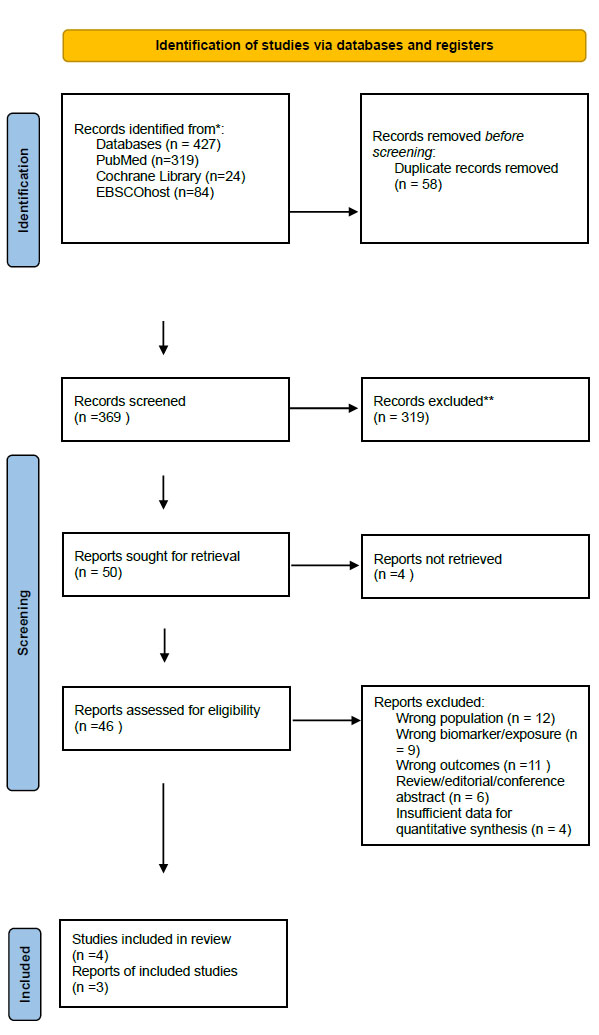
A total of 427 records were identified through database searching, including 319 from PubMed, 24 from the Cochrane Library, and 84 from EBSCOhost. After removal of 58 duplicates, 369 records remained for title and abstract screening. Of these, 319 records were excluded. The full texts of 50 reports were sought for retrieval, of which 4 reports could not be retrieved. Therefore, 46 full-text articles were assessed for eligibility. After full-text review, 42 articles were excluded for the following reasons: wrong population (n = 12), wrong biomarker/exposure (n = 9), wrong outcomes (n = 11), review/editorial/conference abstract (n = 6), and insufficient data for quantitative synthesis (n = 4). Finally, 4 studies were included in the systematic review, and 3 studies were included in the meta-analysis. The study selection process is illustrated in Fig. (1).
3.2. Characteristics of the Included Studies
Four retrospective cohort studies from China and Italy were included in this review [15-18], as summarized in Table 1. The total sample size was 1,381 patients. The mean age of participants ranged from 66 to 73 years, and male patients predominated in all studies (ranging from 65.4% to 86.1%). Two studies assessed the Albumin-to-Fibrinogen Ratio (AFR), whereas two used the Fibrinogen-to-Albumin Ratio (FAR), which was converted to AFR for consistency. The included studies involved patients with bladder cancer at different stages, ranging from Non-Muscle-Invasive Bladder Cancer (NMIBC) to Muscle-Invasive Bladder Cancer (MIBC). Treatment modalities included Transurethral Resection of Bladder Tumor (TURBT) and Radical Cystectomy (RC). Reported outcomes included Overall Survival (OS), Cancer-Specific Survival (CSS), Disease-Specific Survival (DSS), Disease-Free Survival (DFS), Progression-Free Survival (PFS), Time to Progression (TTP), and bladder cancer diagnosis.
3.3. Association Between AFR and Oncological Outcomes
Table 2 summarizes the association between preoperative AFR and oncological outcomes in the four included studies. The AFR cut-off values ranged from 0.08 to 12.21 and were determined using Receiver Operating Characteristic (ROC) curves in most studies. OS was the most frequently reported outcome, and low AFR was consistently associated with poorer OS in the individual studies. For example, Li et al. (2021) [15] reported that an AFR below 12.21 was associated with poorer OS (HR 2.601, p = 0.037), and Claps et al. (2021) [16] reported a similar association using a cut-off of 9.53 (HR 2.24, p = 0.03). Secondary endpoints, including DSS, DFS, CSS, TTP, and PFS, were also evaluated in some studies and showed a similar direction of association, although not all reached statistical significance. The study by Barone et al. (2022) [18] was retained in the qualitative synthesis but excluded from the prognostic meta-analysis because it evaluated bladder cancer diagnosis using an odds ratio rather than a time-to-event survival outcome.
3.4. Risk of Bias
The Newcastle–Ottawa Scale (NOS) was used to appraise the quality of the included studies Table 3. All included studies were considered high quality, with NOS scores ranging from 7 to 9 stars. Most studies presented representative patient samples and well-defined comparison groups. Exposure and outcomes were ascertained using medical records and pathology reports. All studies provided follow-up periods adequate for the assessment of their respective outcomes. Furthermore, most studies adjusted for confounding factors in the analysis. These findings suggest that the included studies were of acceptable methodological quality for assessing the prognostic value of AFR in bladder cancer.
| Author (Year) | Location | Study Design | Age (Mean±SD) | Sex(M/F) | Sample Size | Biomarker | Type of Cancer | Treatment | Outcome |
|---|---|---|---|---|---|---|---|---|---|
| Li S, et al. (2021) [15] | China | Retrospective cohort study | 67.0 ± 10.0 | 273 (76.3%)/85 (23.7%) | 358 patients | AFR | Non-Muscle-Invasive Bladder Cancer (NMIBC) to muscle-invasive bladder cancer (MIBC) | TURBT or Radical Cystectomy (RC) | OS, DSS, DFS |
| Claps F, et al. (2021) [16] | Italy | Retrospective cohort study | 73 ± 8.9 | 161 (65.4%)/85 (34.6%) | 246 patients | AFR | cT1-4aN0M0 BC | Radical Cystectomy (RC) | OS, CSS, TTP |
| Chen J, et al. (2021) [17] | China | Retrospective cohort study | 66.0 ± 10.0 | 230 (86.1%)/37 (13.9%) | 267 patients | FAR | MIBC and high-grade T1 BC | Radical Cystectomy (RC) | OS, PFS |
| Barone B, et al. (2022) [18] | Italy | Retrospective cohort study | 73 ± 10.4 | 413 (81%)/97 (19%) | 510 patients | FAR | Non-Muscle-Invasive Bladder Cancer (NMIBC) to Muscle-Invasive Bladder Cancer (MIBC) |
TURBT | BC diagnosis (low/high grade vs. negative) |
| Author (Year) | Cut-off (AFR) | Outcome | Follow-up Duration | HR / OR (95% CI) | P-value |
|---|---|---|---|---|---|
| Li S, et al. (2021) [15] | 12.21 (ROC) | Overall Survival (OS) | Median 36 months | HR 2.601 (1.057–6.395) | 0.037 |
| Disease-Specific Survival (DSS) | HR 2.189 (0.727–6.590) | 0.164 | |||
| Disease-Free Survival (DFS) | HR 1.971 (1.049–3.703) | 0.035 | |||
| Claps F, et al. (2021) [16] | 9.53 (ROC, AUC=0.73) | Overall Survival (OS) | Median 26 months | HR 2.24 (1.65–2.77) | 0.03 |
| Cancer-Specific Survival (CSS) | HR 2.70 (1.30–5.59) | 0.01 | |||
| Time to Progression (TTP) | HR 2.21 (1.13–4.33) | 0.02 | |||
| Chen J, et al. (2021) [17] | 0.08 (AFR) | Overall Survival (OS) | Median 40 months | HR 2.03 (1.07–3.85) | 0.03 |
| Progression-Free Survival (PFS) | HR 2.33 (1.16–4.68) | 0.017 | |||
| Barone B, et al. (2022) [18] | 1.32 (AFR) | Bladder cancer diagnosis | Not reported | OR = 2.062 (1.378–3.084) | 0.108 |
| Study | Selection | Comparability | Exposure | Total | |||||
|---|---|---|---|---|---|---|---|---|---|
| Representativeness of the Exposed Cohort | Selection of the Non-Exposed Cohort | Ascertainment of Exposure | Demonstration That Outcome of Interest Was Not Present at Start of Study | Comparability of Cohorts on the Basis of the Design or Analysis | Assessment of Outcome | Was Follow-Up Long Enough for Outcomes to Occur | Adequacy of Follow-Up of Cohorts | ||
| Li S, et al. (2021) [15] | * | * | * | * | ** | * | * | * | 9/9 |
| Claps F, et al. (2021) [16] | * | * | * | * | ** | * | * | * | 9/9 |
| Chen J, et al. (2021) [17] | * | * | * | * | ** | * | * | 8/9 | |
| Barone B, et al. (2022) [18] | * | * | * | * | * | * | * | 7/9 | |
3.5. Meta-Analysis of the Association Between AFR and Overall Survival
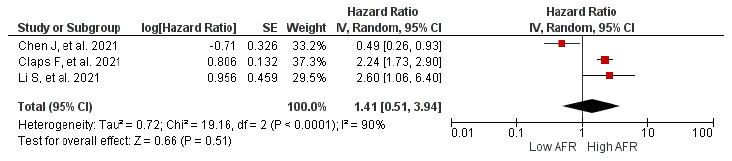
Fig. (2) presents the forest plot of the three studies included in the meta-analysis of the association between preoperative Albumin-to-Fibrinogen Ratio (AFR) and Overall Survival (OS) in patients with bladder cancer. The pooled HR was 1.41 (95% CI: 0.51–3.94; p = 0.51), indicating no statistically significant association between preoperative AFR and overall survival. Although the point estimate suggested a higher risk of mortality in patients with lower AFR, the confidence interval crossed 1, indicating considerable uncertainty in the association. Substantial heterogeneity was observed among the included studies (I2 = 89.6%); therefore, a random-effects model was applied.
4. DISCUSSION
Lower preoperative Albumin-to-Fibrinogen Ratio (AFR) was generally associated with poorer survival outcomes across individual studies, although the pooled meta-analysis did not demonstrate a statistically significant association with overall survival. Several included studies reported that lower AFR or higher Fibrinogen-to-Albumin Ratio (FAR) was associated with unfavorable oncological outcomes, including reduced overall survival and progression-related outcomes [15-17]. These findings may reflect the biological role of systemic inflammation and nutritional status in cancer progression. Fibrinogen has been linked to tumor proliferation, angiogenesis, and metastatic potential, whereas hypoalbuminemia may indicate malnutrition and impaired immune response [9]. Therefore, AFR may provide additional prognostic information in patients with bladder cancer, particularly when used together with other established clinical and pathological factors.
The substantial heterogeneity in the pooled OS analysis (I2 = 89.6%) may be related to differences in patient characteristics, disease stage, treatment modality, AFR/FAR measurement, cut-off values, and follow-up duration. The studies included both NMIBC and MIBC patients treated with TURBT or radical cystectomy. In addition, AFR cut-off values varied widely, ranging from 0.08 to 12.21, and were determined using different methods. These differences may affect the interpretation and generalizability of the pooled results.
These results are consistent with the findings of the individual included studies. Li et al. identified AFR as an independent prognostic factor for OS and DFS in patients with NMIBC and MIBC [15]. Claps et al. demonstrated that patients with an AFR <9.53 had poorer OS, CSS, and TTP after radical cystectomy [16]. Chen et al. reported that a higher Fibrinogen-to-Albumin Ratio (FAR), the inverse of AFR, was independently associated with poorer OS and PFS in patients with MIBC or high-grade T1 bladder cancer undergoing radical cystectomy [17]. Taken together, these findings suggest that AFR may have prognostic relevance across different disease stages and treatment settings; however, the substantial clinical heterogeneity precludes firm conclusions regarding its prognostic performance across these subgroups.
Previous meta-analyses and studies of inflammation-based markers in bladder cancer have not evaluated AFR. Huang Y et al. (2020) evaluated the prognostic value of the systemic immune-inflammation index (SII) in urologic cancers but did not evaluate AFR or FAR [19]. Similarly, Li X et al. (2017) conducted a systematic review and meta-analysis of NLR in urothelial carcinoma, which confirmed the association between higher NLR and poorer survival; however, AFR was not assessed [20]. In addition, Wang X et al. (2024) investigated the prognostic role of the preoperative PLR and interleukin-6 levels in NMIBC without including AFR [21]. Moreover, Wang X et al. (2019) performed a meta-analysis of pretreatment PLR and prognosis in bladder cancer but did not assess AFR or FAR [6]. Therefore, to the best of our knowledge, at the time of the literature search, this was the first systematic review specifically focusing on the prognostic value of AFR/FAR in bladder cancer.
The rationale for focusing on AFR lies in its dual representation of systemic inflammation and nutritional status, which are two important dimensions in cancer prognosis. Albumin reflects nutritional and hepatic function, while fibrinogen is an acute-phase reactant associated with systemic inflammation and tumor progression. As such, AFR may provide additional information by combining these two biological domains in a single marker. The prognostic relevance of AFR should also be interpreted in the context of established nutritional and inflammatory indices, including the Prognostic Nutritional Index (PNI) and Controlling Nutritional Status (CONUT), as well as TNM stage and validated clinicopathological nomograms [22]. Whether AFR provides incremental prognostic information beyond these established variables remains uncertain.
Although AFR integrates nutritional and inflammatory information into a single measure, the available evidence does not establish that AFR provides superior prognostic discrimination compared with albumin or fibrinogen alone. Furthermore, none of the included studies provided sufficient evidence regarding incremental predictive value, such as net reclassification improvement (NRI), integrated discrimination improvement (IDI), or changes in model discrimination after adding AFR to established clinicopathological models [23, 24]. In addition, the prognostic association of AFR may be influenced by potential confounding factors, including tumor stage, comorbidity, nutritional status, and systemic inflammation. Because albumin and fibrinogen are components of AFR and may also be associated with other inflammatory or nutritional indices, potential collinearity with established prognostic variables should also be considered. The included retrospective studies did not provide sufficient evidence to determine the independent contribution of AFR beyond these factors.
In addition to hematological indicators, several prognostic nomograms have been developed to predict outcomes following radical cystectomy. Notable examples include the nomograms developed by a multi-institutional collaborative group to predict all-cause and bladder cancer-specific survival after radical cystectomy [25] and the nomogram developed by an international consortium to predict bladder cancer-specific mortality after neoadjuvant chemotherapy and radical cystectomy [26]. These nomograms incorporate clinical and pathological variables and predict survival with high accuracy. However, although these tools are useful, they rely on complete pathological data that are generally unavailable before surgery. In contrast, AFR is available preoperatively and could complement existing nomograms to further individualize risk stratification.
Clinically, AFR is a readily available and cost-effective prognostic indicator that can be measured using routine preoperative blood tests. Integrating AFR into pretreatment risk stratification algorithms may help identify high-risk patients who may be candidates for intensified surveillance or adjuvant treatment. This is particularly relevant in resource-limited settings, where extensive molecular profiling may not be feasible.
This review has several limitations. First, all included studies were retrospective, which introduces a high risk of selection and reporting bias. Second, the AFR cut-off values differed between studies and were determined using different methods (ROC curve and X-tile analysis), which may have contributed to heterogeneity. This variation underlines the need for future research to identify standardized, clinically relevant AFR cut-off values that can be compared across settings. Third, although FAR was mathematically transformed into AFR when required, unit inconsistencies and transformation bias cannot be completely excluded. Fourth, the small number of included studies (four in the qualitative synthesis and three in the meta-analysis), all conducted in China and Italy, limits the generalizability of the findings and precludes a reliable assessment of publication bias, as funnel plot-based methods are not recommended when fewer than 10 studies are available [27].
The prognostic value of AFR should be validated in large prospective studies. Standardization of cut-off values and integration of AFR into multiparametric prognostic models could improve its clinical applicability in the management of bladder cancer.
CONCLUSION
This systematic review evaluated the prognostic value of preoperative AFR in patients with bladder cancer and included four retrospective cohort studies comprising 1,381 patients. In the individual studies, lower preoperative AFR (or higher FAR) was associated with unfavorable oncological outcomes, including poorer OS, CSS, DFS, PFS, and TTP. However, the pooled analysis of three studies did not demonstrate a statistically significant association between AFR and overall survival (HR 1.41, 95% CI: 0.51–3.94; p = 0.51), and substantial heterogeneity was observed (I2 = 89.6%). Recurrence- and progression-related outcomes were not pooled because of differences in endpoint definitions. Therefore, the current evidence is insufficient to establish AFR as an independent prognostic biomarker in bladder cancer. Nevertheless, because AFR is derived from routine and inexpensive preoperative blood tests, it may represent a potential complementary marker for preoperative risk stratification, particularly in resource-limited settings. Its incremental value beyond established clinicopathological variables, nutritional indices, and nomograms remains uncertain. Large prospective multicenter studies using standardized AFR measurement methods and cut-off values, and evaluating incremental predictive performance, are warranted before AFR can be incorporated into routine clinical practice.
AUTHORS’ CONTRIBUTIONS
The authors confirm their contribution to the paper as follows: Study conception and design: NAS, NCA. Data collection: NCA. Data analysis and interpretation: NAS, T. Manuscript drafting: NCA. All authors reviewed and approved the final manuscript.
LIST OF ABBREVIATIONS
| AFR | = Albumin-to-Fibrinogen Ratio |
| FAR | = Fibrinogen-to-Albumin Ratio |
| OS | = Overall Survival |
| CSS | = Cancer-Specific Survival |
| RFS | = Recurrence-Free Survival |
| PFS | = Progression-Free Survival |
AVAILABILITY OF DATA AND MATERIAL
All data generated or analyzed during this study are included in this published article.
ACKNOWLEDGMENTS
The authors would like to thank the Department of Urology, Dr. Hasan Sadikin General Hospital, Bandung.

