All published articles of this journal are available on ScienceDirect.

Cannulation Challenges and Flow Variability of Arteriovenous Fistulae Among Hemodialysis Patients
 iD
Elona Prifti1
iD
Fjona Nasto2
iD
Mikel Shella3
iD
Xhoela Shtӫmbari4
iD
Senada Kaca5
iD
Sabina Tosuni1
iD
Authors Info & Affiliations
Abstract
Introduction/ Objectives
Difficult cannulation of Arteriovenous Fistulae (AVF) remains a significant challenge, potentially affecting dialysis adequacy and increasing the risk of vascular access complications. This study aimed to assess the prevalence and describe AVF complications and Doppler-derived flow patterns among affected hemodialysis patients.
Methods
This retrospective observational study included adult maintenance hemodialysis patients treated at a single center in Tirana, Albania, between February 2024 and February 2025. Medical records and Doppler ultrasound findings were reviewed. Categorical variables were compared using Fisher’s exact test. Doppler analyses were descriptive because comparable measurements were unavailable for patients without difficult cannulation.
Results
: Of 141 screened patients, 96 had native AVFs, and 33 met the difficult-cannulation definition, representing 23.4% of the screened cohort and 34.4% of patients with native AVFs. Among these 33 patients, 99 Doppler measurements were analyzed: 17.2% showed low flow, 48.5% adequate flow, and 34.3% high flow. Thrombosis occurred in 19 patients (57.6%). AVFs aged 5-10 years had higher odds of calcification than AVFs aged less than 1 year (OR 15.00, 95% CI 1.60–140.20; p = 0.0096). Aneurysm or varicosity was also more frequent in the older group (p = 0.018).
Discussion
Doppler abnormalities were frequent among affected patients, but no association with difficult cannulation can be inferred without a comparison group.
Conclusion
Difficult cannulation was common in this cohort. The observed associations with AVF vintage are exploratory and require confirmation in prospective studies with standardized Doppler protocols and multivariable analysis.
1. INTRODUCTION
Hemodialysis is the most common form of dialysis, with a worldwide prevalence of 89% [1]. A reliably functioning vascular access is required to perform hemodialysis [2]. There are three main types of access: native Arteriovenous Fistula (AVF), arteriovenous graft, and Central Venous Catheter (CVC). The AVF, first described by Brescia and Cimino, remains the preferred choice for chronic hemodialysis [3]. They are typically created in the extremities, and vascular surgeons generally prefer the upper extremities over the lower extremities. The cephalic and basilic veins are often used for the surgical creation of an AVF. However, the radiocephalic type is the preferred initial access for hemodialysis [4]. AVFs are considered the best access for their longevity and have the lowest association with morbidity and mortality, which is why they are strongly recommended in clinical guidelines from different countries [5, 6]. The National Kidney Foundation recommends that an AVF should be placed at least 6 months prior to initiation of HD treatment to allow sufficient time for access creation and evaluation, vein maturation, and, if necessary, maturation-enhancing interventions prior to cannulation. It is therefore recommended that patients with End-stage Renal Disease (ESRD) in the fourth or fifth stages be educated about vascular access modalities to allow sufficient time for access placement. Once autogenous options have been exhausted, prosthetic fistulae become the second option for maintenance HD access. Finally, CVCs are a viable option, particularly in urgent or emergent HD cases, either at the initiation of renal replacement therapy or when a permanent access fails. They are widely available in most dialysis facilities, can be inserted into various central veins, and maturation time is not required, allowing immediate HD [7]. Despite its advantages, AVF use is not without challenges. The most significant complications include lymphedema, infection, aneurysm, stenosis, steal syndrome, ischemic neuropathy, and thrombosis. However, one major issue remains difficult cannulation [8]. It can hinder dialysis adequacy, cause pain, and lead to complications such as hematoma, stenosis, or even access failure. Difficult AVF cannulation may result from anatomical factors, patient comorbidities, inadequate maturation, or progressive changes in fistula flow [9]. Cannulation-related complications, alongside miscannulation, prior CVC use, and high-flow AVFs can increase morbidity [9, 10]. In clinical practice, early recognition of access dysfunction such as repeated cannulation failures or abnormal flow (either decreased or increased) can prevent adverse outcomes.
However, there is limited data available, especially in resource-limited settings, on the prevalence of difficult cannulation, its underlying risk factors, or hemodynamic changes in AVFs [11]. No previous research in Albania has specifically investigated the challenges of difficult Arteriovenous Fistula (AVF) cannulation or the assessment of blood flow in hemodialysis patients. This study aimed to determine the prevalence of difficult cannulation among hemodialysis patients with native AVFs and to describe AVF characteristics, complications, and Doppler-derived flow patterns among patients who experienced difficult cannulation.
2. MATERIALS AND METHODS
2.1. Study Design and Setting
This was a retrospective observational study conducted at the American Hospital 3 Hemodialysis Center, Tiranë, Albania, covering the period from February 2024 through February 2025.
2.2. Inclusion Criteria
Adult patients (≥18 years) receiving maintenance hemodialysis for more than 3 months; patients who underwent at least two dialysis sessions per week during the study period were included. Patients under 18 years old or those with newly created AVFs (<3 months) were excluded..
2.3. Data Collection
Data were extracted from patient medical records. Difficult cannulation was defined according to the 2019 KDOQI Vascular Access Guidelines as: three or more failed needle insertion attempts or more than 15 minutes to achieve successful cannulation, due to anatomical (e.g., stenosis, aneurysms, deep or tortuous veins) or technical factors (e.g., hematoma, infiltration), occurring in two or more documented episodes within one month [12].
Doppler ultrasound examinations were retrospectively reviewed for patients who fulfilled the difficult-cannulation definition. Examinations were performed in the Imaging Department of the American Hospital. The three most recent available Doppler examinations for each patient were reviewed; the interval between examinations was not standardized because of the retrospective design. Flow was categorized as low (<500 mL/min), adequate (500–1500 mL/min), or high (>1500 mL/min). Because Doppler data were unavailable for patients without difficult cannulation, these analyses were descriptive and were not used to estimate the risk of difficult cannulation. Patients with missing data were excluded.
2.4. Data Analysis
Continuous variables were summarized as means and standard deviations, and categorical variables as frequencies and percentages. Fisher’s exact test was used for categorical comparisons because of the small subgroup sizes and sparse cells. No multivariable regression model was fitted because the available subgroup sizes and event distributions were insufficient to support stable adjusted estimates. Therefore, all reported comparisons are unadjusted and exploratory. A two-sided P value ˂ 0.05 was considered statistically significant; no adjustment for multiple comparisons was applied.
3. RESULTS
A total of 141 patients receiving maintenance hemodialysis during this period were screened. Of these, 96 had a native AVF and formed the AVF-specific analytic cohort. 45 patients did not have an AVF and were excluded from that analysis. Among the 96 patients with AVF, 33 patients fulfilled the definition of difficult cannulation, representing 23.4% of the screened sample and 34.4% of AVF patients. AVF type was analyzed only among patients with native AVFs. Brachiocephalic AVFs accounted for 65.6% of the native-AVF cohort and 78.8% of the difficult-cannulation subgroup, whereas radiocephalic AVFs accounted for 34.4% and 21.2%, respectively. Doppler ultrasound records of the 33 patients experiencing cannulation problems were analyzed, with the three most recent examinations per patient selected for assessment. The patient selection flowchart is shown in Fig. (1).
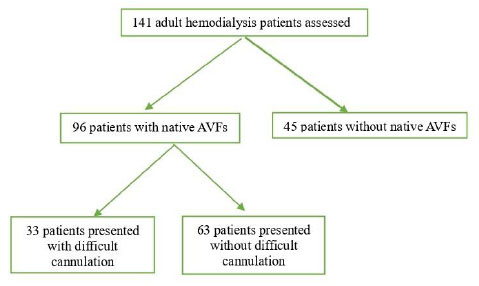
Table 1 summarizes age, dialysis vintage, and AVF vintage across the total screened cohort, the native-AVF cohort, and the difficult-cannulation subgroup. Mean age was broadly comparable across the groups. Patients with difficult cannulation had the longest mean dialysis vintage, at 6.18 ± 3.01 years, compared with 5.65 ± 4.11 years among patients with native AVFs and 4.91 ± 3.94 years in the total screened cohort. Overall AVF vintage was similar between the native-AVF cohort and the difficult-cannulation subgroup. However, when stratified by AVF type, both radiocephalic and brachiocephalic AVFs in the difficult-cannulation subgroup had longer mean vintages than the corresponding AVFs in the overall native-AVF cohort.
| Variables | Total Screened Cohort (n = 141) | Native AVF Cohort (n = 96) | Difficult Cannulation Subgroup (n = 33) |
|---|---|---|---|
| Age (years) | 62.86 ± 11.60 | 65.03± 11.17 | 63.18 ± 10.74 |
| Dialysis Vintage (years) | 4.91.±3.94 | 5.65 ± 4.11 | 6.18 ± 3.01 |
| AVF Vintage (years) | N/A | 4.74 ± 3.00 | 4.48 ± 2.53 |
| RC AVF Vintage (years) | N/A | 4.48±2.53 | 5.71 ± 2.86 |
| BC AVF Vintage (years) | N/A | 4.55 ±3.01 | 6.35 ± 3.01 |
Table 2 summarizes the distribution of sex, comorbidities, and AVF type across the total screened cohort, the native-AVF cohort, and the difficult-cannulation subgroup. A modest male predominance was observed across all groups, with males representing 61.0% of the total screened cohort, 64.5% of the native-AVF cohort, and 63.6% of the difficult-cannulation subgroup. Hypertension was highly prevalent in all groups, affecting 92.2%, 91.7%, and 90.1% of patients, respectively.
| Characteristic | Total Screened Cohort (n = 141) | Native AVF Cohort (n = 96) | Difficult Cannulation Subgroup (n = 33) |
|---|---|---|---|
| Male | 61% | 64.6% | 63.6% |
| Female | 39% | 35.4% | 36.4% |
| Hypertension | 92.2% | 91.7% | 90.9% |
| Cardiovascular comorbidity | 41.1% | 29.2% | 21.2% |
| Diabetes Mellitus (DM) | 31.2% | 26.0% | 15.1% |
The cardiovascular comorbidity variable was defined as the presence of at least one of the following conditions: heart failure, angina, previous myocardial infarction, or valvular heart disease. Patients with more than one of these conditions were counted once in this composite category. Cardiovascular comorbidity was documented in 41.1% of the total screened cohort, 29.1% of the native-AVF cohort, and 21.2% of the difficult-cannulation subgroup. Diabetes mellitus was present in 31.3%, 26.04%, and 15.1% of the corresponding groups.
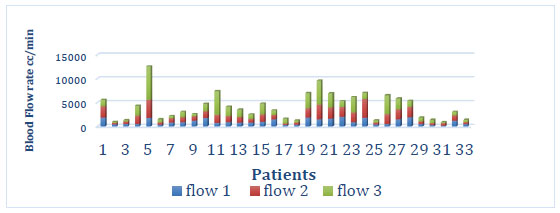
Figure 2 presents three sequential Doppler-derived AVF blood-flow measurements for each of the 33 patients with difficult cannulation, resulting in 99 measurements overall. Flow was categorized as low (<500 mL/min), adequate (500–1500 mL/min), or high (>1500 mL/min). Across all measurements, 17 (17.2%) were classified as low flow, 48 (48.5%) as adequate flow, and 34 (34.3%) as high flow. The proportion of high-flow measurements increased from 24.2% during the first examination to 39.4% during both the second and third examinations, while the proportion of adequate-flow measurements decreased from 54.5% to 45.5%. The mean flow rate increased from 989.4 mL/min in the first examination to 1,410.3 mL/min in the second and 1,766.8 mL/min in the third examination. Across individual patients, 18 showed a consistent increase in flow, 4 showed a consistent decrease, and 11 showed no consistent trend. These findings describe flow variability among patients with difficult cannulation and do not establish an association between abnormal flow and cannulation difficulty because a comparison group without difficult cannulation was not assessed.
Fisher’s exact tests were used to assess associations between AVF vintage or AVF type and selected AVF complications. Results are presented in Table 3. Comparisons by AVF vintage showed no statistically significant differences in thrombosis between AVFs aged <1 year and those aged 1–5 years or 5–10 years, with odds ratios of 0.48 (95% CI: 0.08–2.82; p = 0.59) and 0.40 (95% CI: 0.05–3.06; p = 0.65), respectively. Similarly, no statistically significant differences were observed for phlebitis or steal syndrome across the assessed vintage groups. Calcification did not differ significantly between AVFs aged <1 year and those aged 1–5 years, with an OR of 0.87 (95% CI: 0.12–6.08; p = 0.66). However, AVFs aged 5–10 years had significantly higher odds of calcification than AVFs aged <1 year, with an OR of 15.00 (95% CI: 1.60–140.20; p = 0.0096).
| Complication | Comparison | Odds Ratio | 95% CI | Fisher’s Exact P-value |
|---|---|---|---|---|
| Thrombosis | <1 year vs. 1–5 years | 0.48 | 0.08–2.82 | 0.59 |
| Thrombosis | <1 year vs. 5–10 years | 0.40 | 0.05–3.06 | 0.65 |
| Calcification | <1 year vs. 1–5 years | 0.87 | 0.12–6.08 | 0.66 |
| Calcification | 5–10 years vs. <1 year | 15.00 | 1.60–140.20 | 0.0096 |
| Aneurysm/ varicosity |
<1 year vs. 1–5 years | Not estimable | Not estimable | 0.55 |
| Aneurysm/ varicosity |
5–10 years vs. <1 year | Not estimable | Not estimable | 0.018 |
| Thrombosis | BC vs. RC | 1.67 | 0.25–11.20 | 0.65 |
| Phlebitis | BC vs RC | 0.42 | 0.03–5.30 | 1 |
| Steal syndrome | BC vs. RC | 1.19 | 0.11–12.39 | 1 |
| Calcification | BC vs. RC | 0.31 | 0.04–1.93 | 0.19 |
| Aneurysm/ varicosity |
BC vs RC | 1.19 | 0.11–12.39 | 1 |
Aneurysm or varicosity was not significantly different between AVFs aged <1 year and those aged 1–5 years (p = 0.55). In contrast, aneurysm or varicosity was significantly more frequent among AVFs aged 5–10 years than among those aged <1 year (p = 0.018). The odds ratio for this comparison was not estimable because of a zero cell in the contingency table. Comparisons according to AVF type did not show statistically significant differences in thrombosis, phlebitis, steal syndrome, calcification, or aneurysm/varicosity between brachiocephalic and radiocephalic AVFs. The corresponding p-values were 0.65, 1.00, 1.00, 0.19, and 1.00, respectively. Because of the small subgroup sizes, sparse cells, and multiple comparisons, these findings should be interpreted as exploratory associations rather than evidence of independent predictors.
4. DISCUSSION
This study provides important insights into the challenges of AVF cannulation in hemodialysis patients. Our study showed a male predominance (61%) and a mean participant age of 62.86 years, which is consistent with demographic profiles observed in other regions, such as Mexico, where the reported mean age was 58 years [13]. The European Renal Association Registry stated in 2019 that the median age for prevalent hemodialysis patients in Europe was 60.5 years [14]. In the Middle East, it was relatively lower, which may reflect a younger general population, a higher prevalence of risk factors at younger ages, and differences in reporting [15, 16].
The prevalence of difficult cannulation in our population (23.4%) emphasizes a multifactorial problem influenced by patient age, dialysis vintage, and vascular access characteristics. This percentage falls within the range reported by international studies, although making direct comparisons is challenging due to variations in study designs, patient characteristics, and definitions. A systematic review by Lawson et al. showed that complication rates varied widely, in part due to inconsistent reporting and differing methodologies [17]. Few studies have looked at this issue specifically, but the ones that did reported miscannulation rates of about 4.4% [18] and AVF failure rates ranging from 8.6% to 12.1% in other settings [19, 20].
Hypertension was present in 90%-92% of our patients. A 2022 review pointed out that cardiovascular disease affects more than two-thirds of individuals receiving HD [21]. Comorbidities were less common in the cannulation difficulty group compared with those in the native-AVF cohort and the total population. This may be due to the fact that patients with severe comorbidities such as heart failure are not eligible for fistula creation, and those with diabetes have compromised vasculature [22].
A notable finding was the predominance of Brachiocephalic (BC) AVFs (65.6%), which exceeds the proportions reported in Australia and the USA, where brachiocephalic AVFs are used in 58.6%, 39%, and 56% of cases, respectively [18, 23, 24]. Although guidelines recommend Radiocephalic (RC) AVFs as the first-line option [25], the trend in our center appears to be the opposite. This may be attributed to practical considerations and anatomical limitations in our older population. Another reason, evident in our patients’ medical records, is the high incidence of early RC AVF failure. In the cannulation-difficulty group, BC fistulas had a longer vintage (6.35 ± 3.01 years) than RC fistulas (5.71 ± 2.86 years), suggesting that BC accesses were often created as secondary options after RC failure. This pattern, not evident in the overall AVF population, supports the role of AVF aging and access history in the development of cannulation-related challenges.
Thrombosis was the most frequently observed complication (19/33 patients), consistent with global incidence rates of 60% in other dialysis settings [26, 27].
These observations are consistent with the gradual structural changes and repeated cannulation-related injury that occur in AVFs over long-term use [28]. In the difficult-cannulation subgroup, 48.5% of the 99 Doppler measurements were within the adequate flow range, whereas 17.2% showed low flow and 34.3% showed high flow. These results describe flow variability among patients who had already experienced difficult cannulation. Previous studies have reported potential benefits of access blood-flow surveillance and a role for imaging in the assessment of difficult cannulation, providing clinical context for these observations [29, 30]. The exploratory analysis also found higher odds of calcification among AVFs aged 5-10 years compared with AVFs aged ˂1 year, while aneurysm/varicosity was more frequent in the older group. These findings may be compatible with progressive structural changes in mature vascular accesses [31].
Although previous studies have examined difficult cannulation, imaging, access blood-flow surveillance, and AVF calcification separately, few have specifically described serial Doppler flow variability among patients with documented difficult cannulation. Future prospective studies with standardized Doppler protocols, appropriate comparison groups, and consistent definitions of difficult cannulation are needed to determine their clinical significance.
STUDY LIMITATIONS
Several limitations should be noted when interpreting these findings. First, the single-center design and the use of consecutive, non-probability sampling strategies included in this study limit generalizability of the findings. Furthermore, the high prevalence of brachiocephalic AVF and patient characteristics may be representative of local surgical practices and may not be representative of other hemodialysis populations. Secondly, the retrospective design of this study relies on the accuracy and completeness of medical records. Documentation surrounding difficult cannulations may also differ from clinician to clinician, and some cases may have been underreported. Thirdly, the study included only bivariate analyses and did not provide multivariable adjustment for age, dialysis vintage, AVF vintage, diabetes, cardiovascular comorbidity, or AVF type. The small number of radiocephalic AVFs in the difficult-cannulation subgroup, along with sparse or zero cells, also limited the stability of the adjusted models. Accordingly, the reported associations should be interpreted as exploratory and should not be described as independent predictors. In addition, multiple comparisons were performed without adjustment, increasing the possibility of type I error.
Finally, the cross-sectional nature of the study captures associations but does not establish causality between flow abnormalities, complications, and cannulation difficulty. Longitudinal studies are needed to clarify the temporal sequence of these relationships.
CONCLUSION
Difficult cannulation affected 34.4% of patients with native AVFs in this cohort, confirming that it remains a common practical problem in routine hemodialysis care. Among affected patients, Doppler measurements varied widely, and older fistulas more often exhibited calcification and aneurysmal or varicose changes. Because of the retrospective design, the absence of a comparison group without difficult cannulation, and the small subgroup sizes, these associations should be regarded as hypothesis-generating rather than as evidence of causation or of independent predictors. The findings nevertheless support closer surveillance of mature fistulas and systematic documentation of cannulation difficulty. Prospective studies with standardized Doppler protocols are needed to determine whether flow patterns and structural changes predict difficult cannulation and whether targeted surveillance improves access outcomes.
AUTHORS’ CONTRIBUTIONS
The authors confirm their contribution to the paper as follows: Concept: P.P., EP.; Design: P.P., EP.; Data collection or processing: M.Sh., S.K.; Analysis and/or interpretation: S.T., F.N.; Literature review: F.N., Xh.Sh.; Writing: P.P., E.P., F.N.; Critical review: F.N., M.Sh. All authors have read and approved the final manuscript and agree to be accountable for all aspects of the work.
LIST OF ABBREVIATIONS
| AVF | = Arteriovenous Fistula |
| AVG | = Arteriovenous Graft |
| BC | = Brachiocephalic |
| CDK | = Chronic kidney disease |
| CVC | = Central Venous Catheter |
| HD | = Hemodialysis |
| KDOQI | = Kidney Disease Outcomes Quality Initiative |
| R-B | = Radiocephalic |
ETHICS APPROVAL AND CONSENT TO PARTICIPATE
This study was carried out on the basis of the administrative permission granted by the Hemodialysis Center, American Hospital 3 (Prot. No. 30; Date 17.01.2024). All patient data were anonymized, and confidentiality was strictly maintained in accordance with applicable data protection regulations.
HUMAN AND ANIMAL RIGHTS
All procedures involving human participants were conducted in accordance with the ethical standards of the committee responsible for human experimentation (institutional and national), and with the Helsinki Declaration of 1975, as revised in 2013.
CONSENT FOR PUBLICATION
Informed consent to participate was not required because this was a retrospective study based on the review of existing medical records, with no direct patient contact or intervention.
AVAILABILITY OF DATA AND MATERIALS
The data from patients’ medical records can be provided upon request.
ACKNOWLEDGEMENTS
Declared none.

