All published articles of this journal are available on ScienceDirect.

Pressure-Controlled and Suction-Assisted Ureteroscopy: A Systematic Review and Meta-analysis of Fluid Dynamics and Perioperative Safety

Abstract
Introduction
Intrarenal Pressure (IRP) influences the safety of Ureteroscopy (URS) and Retrograde Intrarenal Surgery (RIRS), with excessive pressure potentially contributing to fluid absorption and infectious complications. This review evaluated the effects of pressure-modulating devices on fluid absorption, pressure dynamics, and perioperative outcomes in URS/RIRS.
Methods
A PRISMA-based systematic review was conducted and registered in PROSPERO (CRD420251238560). PubMed, Cochrane, and EBSCO were searched. Eligible studies were assessed using ROB 2 or the Newcastle–Ottawa Scale. Random-effects meta-analysis was performed for comparable outcomes.
Results
Four studies were included, comprising two randomized trials and two observational cohorts. Pressure-modulating systems significantly reduced fluid absorption (MD −159.71 mL; 95% CI −264.05 to −55.37; p = 0.003) and operative time (MD −22.93 min; 95% CI −45.28 to −0.58; p = 0.04). Postoperative fever was not significantly reduced (RD −0.05; 95% CI −0.18 to 0.08; p = 0.43).
Discussion
Pressure-modulating systems were associated with lower irrigation fluid absorption and shorter operative time. However, the reduction in postoperative fever was not statistically significant. Differences in devices, irrigation protocols, and pressure measurement methods may explain the variability between studies.
Conclusion
Available evidence suggests that intrarenal pressure–modulating devices enhance procedural safety during URS and RIRS by improving fluid dynamics without compromising treatment effectiveness. Further large-scale, multicenter trials are warranted to establish optimal pressure targets, harmonize outcome reporting, and clarify long-term clinical and economic implications.
1. INTRODUCTION
Ureteroscopy (URS) is a widely adopted procedure for managing upper urinary tract stones, supported by continuous advancements in flexible ureteroscopes, laser lithotripsy, and Ureteral Access Sheaths (UAS) [1, 2]. Despite its efficacy, URS carries risks related to Intrarenal Pressure (IRP) and irrigation fluid absorption. Elevated Renal Pelvic Pressure (RPP) has been associated with pyelovenous and pyelolymphatic backflow, potentially leading to postoperative fever, urosepsis, and ureteral injury [3-6]. Clinical studies report that infectious complications such as postoperative fever occur in approximately 4–8% of URS cases, while urosepsis develops in 0.5– 5% depending on patient risk factors and intraoperative pressure levels [7, 8].
To address these concerns, a new generation of intrarenal pressure–modulating devices, including suction-assisted UAS, negative-pressure access sheaths, and intelligent pressure-control platforms, has been introduced. These systems aim to stabilize RPP, enhance outflow, minimize pressure surges, and reduce intrarenal fluid absorption, thereby improving procedural safety [9-13]. Early clinical trials suggest that device-based pressure regulation may reduce fluid absorption, shorten operative time, and maintain high Stone-Free Rates (SFR), positioning these technologies as promising adjuncts in modern URS [14, 15].
However, available evidence remains fragmented. Studies differ substantially in their pressure measurement techniques (pressure wires, fiber-optic sensors, ethanol absorption models), irrigation strategies, and definitions of clinical outcomes [10, 16, 17]. Although both randomized trials and observational cohorts have evaluated individual devices, no prior systematic review has specifically synthesized their impact on fluid absorption, pressure dynamics, and patient outcomes during URS.
Therefore, this systematic review aims to critically evaluate current evidence on intrarenal pressure–modulating devices, focusing on their effects on fluid absorption, pressure dynamics, and clinical outcomes during URS.
2. METHODS
2.1. Protocol and Registration
This systematic review was planned and conducted in accordance with the PRISMA 2020 reporting standards [18]. The study protocol was prospectively registered with the International Prospective Register of Systematic Reviews (PROSPERO) under registration number CRD420251238560 prior to data extraction and analysis.
2.2. Literature Search
A structured literature search was performed using PubMed, Cochrane, and EBSCOhost, covering all records available from database inception to August 2025. The search strategy incorporated a combination of Medical Subject Headings (MeSH) terms and free-text keywords related to ureteroscopy, intrarenal pressure, renal pelvic pressure, ureteral access sheaths, suction systems, and irrigation fluid absorption. Boolean operators were applied to broaden and refine the search. The full search strategies for each database are provided in the Supplementary Material.
2.3. Eligibility Criteria
Studies were considered eligible if they fulfilled the following criteria:
- Involved adult patients undergoing semi-rigid or flexible ureteroscopy.
- Reported quantitative data on intrarenal or renal pelvic pressure, irrigation fluid absorption, or pressure-related perioperative outcomes.
- Employed original clinical study designs, including randomized controlled trials or observational cohort studies.
Studies were excluded if they were case reports, narrative reviews, conference abstracts, animal or laboratory-based investigations, lacked relevant quantitative data, or represented duplicate patient populations.
2.4. Study Selection Process
Two investigators independently reviewed titles and abstracts to identify potentially relevant studies. Full texts of eligible articles were subsequently assessed. Any disagreement regarding study inclusion was resolved through discussion until consensus was achieved.
2.5. Data Collection
Data extraction was performed using a predefined standardized template. Extracted information included study characteristics (author, year of publication, country, study design, and sample size), patient demographics (age, sex, and stone size), procedural details (type of ureteroscopy, ureteral access sheath characteristics, irrigation approach, and pressure or fluid absorption measurement techniques), and reported outcomes such as operative time, stone-free rate, intrarenal pressure values, irrigation fluid absorption, and postoperative complications.
2.6. Assessment of Methodological Quality
The risk of bias in randomized controlled trials was evaluated using the Cochrane Risk of Bias 2 (ROB 2) tool. Observational studies were assessed with the Newcastle–Ottawa Scale (NOS). Quality assessment was conducted independently by two reviewers, with discrepancies resolved by consensus.
2.7. Data Synthesis and Analysis
Due to variations in study designs, device characteristics, pressure-monitoring methods, and outcome definitions, the results were primarily synthesized using a narrative approach. Study findings were summarized descriptively and presented in tabular format.
When outcome data were sufficiently comparable across studies, a limited quantitative synthesis was undertaken. Meta-analyses were performed for selected outcomes reported by at least two studies, including fluid absorption, operative duration, and postoperative fever. Continuous variables were pooled using mean differences, while dichotomous outcomes were analyzed using risk differences, both with corresponding 95% confidence intervals. A random-effects model was applied to account for inter-study variability, and heterogeneity was evaluated using the I2 statistic. Statistical analyses were conducted using Review Manager (RevMan) software.
3. RESULTS
3.1. Study Selection
The database search identified a total of 337 records (PubMed = 114, Cochrane =54, EBSCOhost = 169). After removal of 76 duplicates, 261 records remained for screening. Following title and abstract screening, 207 records were excluded. A total of 54 full-text articles were assessed for eligibility, of which 50 were excluded (irrelevant population or procedure, n = 18; no outcomes on intrarenal pressure or fluid absorption, n = 12; review articles, n = 11; conference abstracts, n = 6; animal/in vitro studies, n = 3). Finally, 4 studies met the inclusion criteria and were included in both qualitative and quantitative synthesis (Fig. 1).
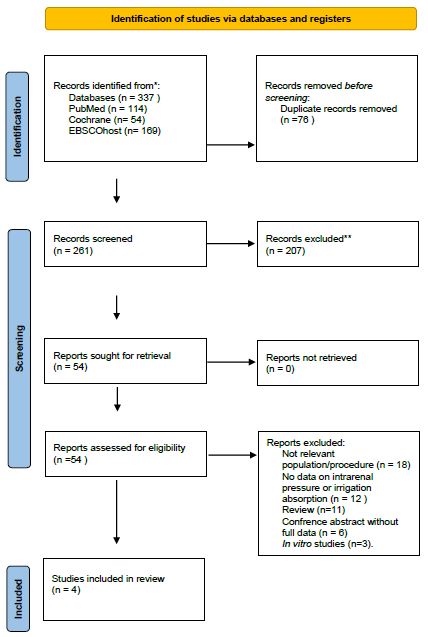
PRISMA 2020 Flowchart.
As shown in Table 1, four primary studies were included, comprising two randomized controlled trials and two observational cohorts, with sample sizes ranging from 73 to 231 patients. Across all studies, participants were adult patients undergoing ureteroscopy or retrograde intrarenal surgery for upper urinary tract stones, with mean or median ages generally ranging from the mid-40s to the late-50s. The sex distribution was relatively balanced, although the multicenter cohort by Bai et al. [10] included a higher proportion of male patients. Stone size differed by study design: both RCTs enrolled patients with stones measuring approximately 15–17 mm, whereas the retrospective multicenter series evaluated larger stone burdens, with a median size of 26 mm.
| Author (Year) | Country / Setting | Design | Total N | Intervention (N) | Control (N) | Age (yrs) | Sex (M/F) | Stone Size | Inclusion Criteria | Exclusion Criteria |
|---|---|---|---|---|---|---|---|---|---|---|
| Croghan et al. (2022) [17] | Ireland (4 hospitals) | Prospective, multi-institutional, blinded IRP measurement | 120 | – | – | 57.5 ± 13.4 | 70/50 | NA | ≥18 yrs, undergoing URS or FURS for stones/diagnostic | <18 yrs, refusal |
| Chen YJ et al. (2024) [19] | China (Ganzhou People’s Hospital) | RCT, single center | 76 (80 enrolled, 4 excluded) | A:0 mmHg (18) B:–5 mmHg (19) C:–10 mmHg (19) | D: uncontrolled (20) | 47.5 (mean) | NR | 15–17 mm | ASA I–II, ≥18 yrs, upper tract stones | Prior surgery, systemic disease, ethanol allergy, uncontrolled UTI, malpositioned UAS. |
| Deng et al. (2024) [14] | China | RCT, single center | 73 (80 enrolled, 7 excluded) | A:–5 mmHg (19) B:0 mmHg (17) C:+5 mmHg (18) | D: uncontrolled (19) | 46.5–49.5 | 38/35 | 15–17 mm | Stones <2 cm, age 18–70, elective FURS | Stricture, prior surgery, fibrosis, severe hydronephrosis, pregnancy, infection. |
| Bai et al. (2024) [10] | China (6-center Fujian cohort) | Retrospective multicenter | 231(254 screened) | FANS- UAS: 231 | – | Median 55 (21–80) | 147/84 | Median 26 mm (20–57) | Stones ≥2 cm, RIRS with FANS-UAS | Failed UAS, conversion to PCNL, contraindications. |
3.2. Interventions and Outcomes
As summarized in Table 2, the four studies showed substantial variation in ureteroscopic devices and pressure-control technologies, yet demonstrated a consistent overall pattern. Croghan et al. [17], using conventional UAS without suction and standard gravity or pressurized irrigation, reported marked intrarenal pressure fluctuations with high peaks associated with postoperative infectious events. In contrast, the three suction-enabled or pressure-controlled systems evaluated by Chen et al. [19], Deng et al. [14], and Bai et al. [10] employed 12/14 Fr access sheaths with integrated suction or automated pressure regulation, resulting in more stable renal pelvic pressures, markedly reduced fluid absorption, and shorter operative times, while maintaining comparable stone-free rates and low complication profiles. Collectively, Table 2 illustrates that pressure-modulating UAS improve intraoperative fluid dynamics and procedural safety without compromising efficacy.
| Author | URS Type | UAS Type (Size) | Suction/Pressure Control | Irrigation Method | Pressure Measurement | Outcomes Measured | Key Findings |
|---|---|---|---|---|---|---|---|
| Croghan et al. (2022) [17] | Semi-rigid URS + FURS | Mostly 11/13 Fr | Non-device(no suction, no pressure-control) | Gravity 50 cm; pressurized 100–200 mmHg; manual syringe | COMET II pressure guidewire | IRP (baseline, intraop), fever/urosepsis | Mean baseline IRP 16.5 mmHg; intra-op mean 40 mmHg; peaks to 334 mmHg. Higher IRP variance associated with postoperative pyrexia/urosepsis. |
| Chen YJ et al. (2024) [19] | Flexible URS | 12/14 Fr suction UAS | Intelligent pressure-control system | Flow 50–150 mL/min saline + 1% ethanol | Exhaled ethanol (Hahn formula) | Fluid absorption, op time, labs, complications | Lower fluid absorption (≈58–118 mL vs 208 mL control) and shorter operative time; SFR preserved; complications similar. |
| Deng et al. (2024) [14] | Flexible URS | 12/14 Fr patented UAS | Automated suction + pressure sensor | Pump irrigation 100 mL/min | Ethanol marker method | Fluid absorption, RPP, SFR, complications | RPP lower in controlled groups; absorption increased with higher RPP; complications (fever/vomit/injury) more frequent at higher RPP; SFR ~88–95%. |
| Bai et al. (2024) [10] | Digital FURS | 12/14 Fr FANS-UAS | Negative-pressure suction UAS | Pump irrigation 100 mL/min | Fiber-optic IRP probe (30 pts) | IRP regional, SFR, NRS pain, complications | ISFR 90.5%; 30-day 95.7%; complications 1.7%; IRP ~18–22 mmHg; suction could drop pressure below −30 mmHg when activated. |
3.3. Meta-Analysis Results
Across the two randomized controlled trials that provided quantitative data, pressure-controlled ureteroscopic systems consistently demonstrated physiological advantages over standard UAS. Fluid absorption was significantly lower in the pressure-controlled groups, with the pooled estimate showing a reduction of −159.71 mL (95% CI −264.05 to −55.37; p = 0.003), as illustrated in Fig. (2). Similarly, operative time favored pressure-controlled techniques, with a combined mean difference of −22.93 minutes (95% CI −45.28 to −0.58; p = 0.04), despite substantial heterogeneity (I2 = 77%; Fig. 3). These findings indicate that maintaining a fixed or negative renal pelvic pressure may enhance surgical efficiency and reduce fluid ingress during RIRS. In contrast, postoperative fever did not differ significantly between groups. The pooled risk difference was −0.05 (95% CI −0.18 to 0.08; p = 0.43), with moderate heterogeneity (I2 = 47%; Fig. 4). This lack of statistical difference likely reflects the low incidence of infectious complications and limited sample sizes across studies. Overall, the meta-analysis supports the physiological benefits of pressure-modulating devices during ureteroscopy, while highlighting that their impact on short-term infectious outcomes remains inconclusive.
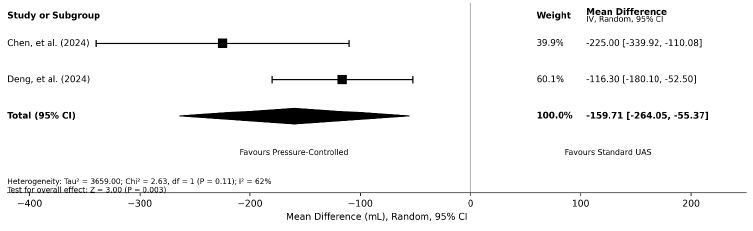
Forest Plot of Fluid Absorption.
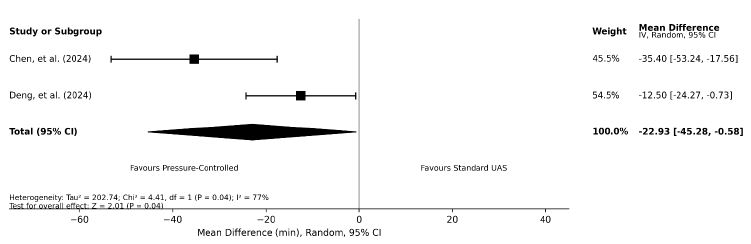
Forest Plot of Operative Time.
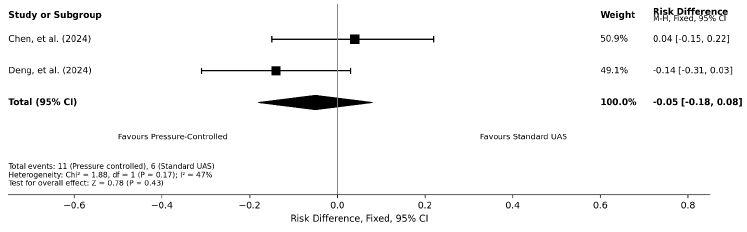
Postoperative Fever.
3.4. Risk of Bias
The risk of bias assessment indicated acceptable methodological quality across studies. The two RCTs (Chen YJ et al. 2024 [19]; Deng et al. 2024 [14]) were rated as having overall some concerns due to deviations from intended interventions and selective reporting, despite low risk in other domains (Fig. 5). The observational studies scored 7/9 (Bai et al. 2024) [10] and 8/9 (Croghan et al. 2022) [17] on the NOS, indicating low to moderate risk of bias Table 3.
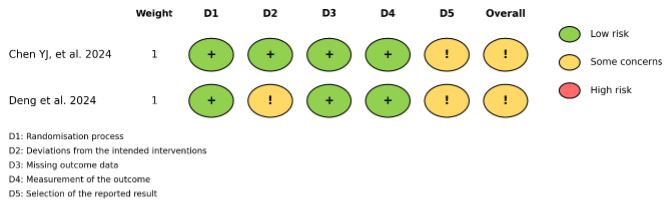
RoB 2. Risk-of-Bias Summary for the Included Randomized Controlled Trials Using the Cochrane Risk of Bias 2 (RoB 2) Tool.
| Study | Representativeness of exposed cohort | Selectio n of non- exposed cohort | Ascertainment of exposure | Outcome not present at start | Comparability of cohorts | Assessment of outcome | Follow-up long enough | Adequacy of follow-up | Total (0–9) |
|---|---|---|---|---|---|---|---|---|---|
| Bai et al., (2024) [10] |

|
– |
|
|
|
|
|
|
7 |
| Croghan et al., (2024) [17] |
|
|
|
|
|
|
|
|
8 |
4. DISCUSSION
This review highlights the consistent association between Intrarenal Pressure (IRP) and perioperative outcomes in Ureteroscopy (URS) and Retrograde Intrarenal Surgery (RIRS). Across two Randomized Controlled Trials (RCTs) and two observational cohorts, pressure-controlled and suction-assisted Ureteral Access Sheaths (UAS) were consistently shown to reduce intrarenal pressure, limit irrigation fluid absorption, and shorten operative time while maintaining high Stone-Free Rates (SFR) [10, 20]. These findings are consistent with the hypothesis that elevated Renal Pelvic Pressure (RPP) promotes pyelovenous and pyelolymphatic backflow, potentially leading to infectious complications. Clinical studies have reported that postoperative fever occurs in approximately 4–8% of URS cases, while urosepsis develops in 0.5–5% of cases, depending on patient risk factors and intraoperative conditions [8, 21, 22].
The prospective study by Croghan et al. demonstrated that intraoperative IRP can peak at 334 mmHg, and that greater pressure variability was strongly associated with postoperative pyrexia and urosepsis [17]. Although elevated intrarenal pressure has been implicated in postoperative infectious events, an exact pressure threshold associated with these complications remains uncertain. Croghan et al. reported substantial variability in intraoperative pressure measurements, with peak values exceeding 300 mmHg in some cases. Notably, postoperative pyrexia and urosepsis appeared to be associated with greater pressure fluctuations rather than a distinct pressure cutoff. Consequently, current evidence supports strategies aimed at reducing pressure variability and avoiding excessive intrarenal pressure excursions during URS and RIRS [4, 16, 17, 23, 24].
Intrarenal pressure is also influenced by irrigation settings. Across the included studies, irrigation protocols ranged from gravity-assisted irrigation to automated pump systems delivering 50–150 mL/min, with or without suction-assisted outflow. Because irrigation flow rate, ureteroscope deflection, and ureteral access sheath characteristics all affect intrarenal pressure, direct comparison of absolute pressure values between studies remains challenging. Standardized irrigation protocols will be essential for defining clinically relevant pressure thresholds in future investigations [10, 14, 17, 25, 26].
In contrast, both Chen et al. and Deng et al. showed that negative or fixed RPP control significantly reduced fluid absorption and procedure duration without compromising SFR [14, 19]. Similarly, Bai et al. reported excellent stone clearance (>95% at 30 days) and minimal complication rates (1.7%) using a negative-pressure FANS-UAS system [10]. These data align with experimental studies that identified high pelvic pressures as a risk factor for infectious sequelae, although systematic reviews on this topic remain scarce and fragmented [3, 4, 25, 27].
The pooled analysis performed in this review supports these findings by demonstrating significant reductions in both irrigation fluid absorption and operative time. Pressure-controlled UAS significantly reduced fluid absorption (MD −159.71 mL, 95% CI −264.05 to −55.37) and shortened operative time (MD −22.93 minutes, 95% CI −45.28 to −0.58). However, postoperative fever did not differ significantly between groups (RD: −0.05; 95% CI: −0.18 to 0.08), likely due to the inherently low event rates and limited sample sizes. These results suggest that pressure modulation improves physiological and operative efficiency, although its impact on infectious outcomes may require larger populations to demonstrate statistical significance.
From a clinical standpoint, suction-enabled or pressure-regulated UAS represent a practical strategy to enhance safety in RIRS, as these systems stabilize RPP, minimize pressure spikes, and reduce the volume of absorbed irrigation fluid [10, 14, 17, 19]. Although infectious outcomes did not consistently reach statistical significance, this is plausibly attributed to underpowered sample sizes and the relatively low frequency of severe postoperative infections. In the absence of clear, evidence-based pressure thresholds, pressure-modulating systems may represent a useful strategy for improving intraoperative fluid dynamics, particularly in patients at increased risk of infectious complications. However, additional evidence is required before their routine adoption can be universally recommended. Current international guidelines (EAU, AUA) acknowledge the potential harms of elevated IRP but do not define safe pressure limits or recommend specific UAS technologies, underscoring the need for stronger clinical evidence [28, 29].
This review also reveals important knowledge gaps. Only four eligible studies were identified, resulting in limited statistical power despite the feasibility of pooled analyses for selected outcomes. The heterogeneity in devices (Storz, Olympus, PUSEN, and FANS-UAS), pressure-monitoring techniques (pressure guidewires, fiber-optic sensors, and ethanol-based absorption methods), and irrigation protocols limits the ability to define a universal safe intrarenal pressure threshold [10, 14, 17, 19, 27, 30]. Furthermore, all but one study were conducted in China, with a single European cohort, raising questions about the generalizability of the findings to other healthcare settings. None of the included studies evaluated patient-reported outcomes such as pain or quality of life, nor did they assess long-term renal function recovery. The economic impact of suction UAS and pressure-control platforms also remains unexplored. Future multicenter RCTs are needed to standardize IRP thresholds, harmonize clinical outcome definitions, evaluate cost-effectiveness, and incorporate patient-centered measures, while technological advancement should continue toward real-time IRP-guided surgical systems [20, 21, 31].
A specific limitation warranting explicit acknowledgment is the small number of eligible studies and the correspondingly limited statistical power of the pooled estimates. Only four studies met the inclusion criteria, and the quantitative synthesis for fluid absorption and operative time was derived from just two randomized controlled trials, while the risk-difference estimate for postoperative fever pooled data from a similarly small number of studies. With such small numbers of trials, the pooled effect estimates are inherently imprecise, as reflected in the wide confidence intervals accompanying each outcome (fluid absorption: 95% CI −264.05 to −55.37 mL; operative time: 95% CI −45.28 to −0.58 minutes; postoperative fever: 95% CI −0.18 to 0.08), and the analysis was not supported by a formal a priori power or sample-size calculation, which is a recognized constraint of meta-analyses conducted on emerging surgical technologies with few available trials [27, 30]. The non-significant result for postoperative fever most plausibly reflects a type II error arising from the low baseline event rate of infectious complications in URS/RIRS combined with the small pooled sample, rather than a true absence of effect, consistent with sample-size considerations raised in comparable meta-analyses of ureteral access sheath interventions [27, 30, 32]. Consequently, the findings on fluid absorption and operative time should be interpreted as indicative rather than definitive, and the fever outcome should be regarded as inconclusive because the review was underpowered to detect a clinically plausible reduction in infectious complications rather than because no such reduction exists. These considerations also limit the generalizability of the pooled estimates, since the included cohorts predominantly originated from single-center or regional settings; larger, adequately powered multicenter randomized trials with prespecified sample-size calculations are required before firm conclusions on infectious outcomes can be drawn.
CONCLUSION
This systematic review and meta-analysis demonstrate that pressure-controlled and suction-assisted ureteral access sheaths significantly reduce intrarenal fluid absorption and shorten operative time during URS/RIRS, while maintaining high procedural efficacy. Although postoperative fever did not differ significantly between pressure-controlled and standard systems, this likely reflects the low incidence of infectious complications and limited sample sizes across available studies. Collectively, the available evidence suggests that pressure modulation improves intraoperative fluid dynamics and procedural efficiency, although its impact on postoperative infectious complications remains uncertain. Larger multicenter randomized trials with standardized pressure metrics and patient-centered outcomes are needed to establish safe intrarenal pressure thresholds and inform future guideline recommendations.
LIST OF ABBREVIATIONS
| AUA | American Urological Association |
| CI | Confidence Interval |
| EAU | European Association of Urology |
| FANS-UAS | Flexible and Navigable Suction Ureteral Access Sheath |
| FURS | Flexible Ureteroscopy |
| IRP | Intrarenal Pressure |
| IRB | Institutional Review Board |
| MD | Mean Difference |
| MeSH | Medical Subject Headings |
| NOS | Newcastle–Ottawa Scale |
| PCNL | Percutaneous Nephrolithotomy |
| PRISMA | Preferred Reporting Items for Systematic Reviews and Meta-Analyses |
| PROSPERO | International Prospective Register of Systematic Reviews |
| RCT | Randomized Controlled Trial |
| RD | Risk Difference |
| RIRS | Retrograde Intrarenal Surgery |
| ROB | Cochrane Risk of Bias 2 |
| RPP | Renal Pelvic Pressure |
| SFR | Stone-Free Rate |
| UAS | Ureteral Access Sheath |
| URS | Ureteroscopy |
AUTHORS’ CONTRIBUTIONS
The authors confirm their contributions to the paper as follows:
Study conception and design: N.A.S., T.; data collection: N.A.S.; analysis and interpretation of results: N.A.S., T.; draft manuscript preparation: N.A.S., T. All authors reviewed the results and approved the final version of the manuscript.
AVAILABILITY OF DATA AND MATERIAL
This systematic review and meta-analysis is based exclusively on previously published studies that are publicly available in the literature. No new primary data were generated or analyzed. All included studies are cited in the reference list and accessible through their respective journals. The study protocol is registered in PROSPERO under registration number CRD420251238560.
ACKNOWLEDGEMENTS
The authors would like to thank the Department of Urology, Padjadjaran University, Indonesia, for their institutional support throughout the conduct of this study.

